Products
Wildflower Turfgrass
Call For a Quote
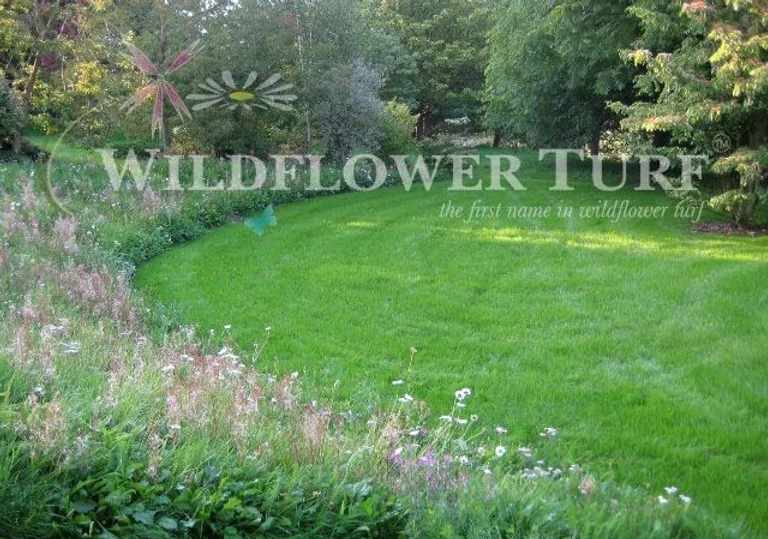
Wildflower meadows are an ideal candidate within low maintenance schemes as they need only ONE annual cut during the Autumn period. This maintenance regime compares favourably to say, a normal lawned area, where mowing is required once every ten days approx during the growing season. Furthermore, wildflower turfgrass can be used in collaboration within a normal lawned area, to create beds and borders, the flowers creating the seasonal pallet of colours and structure normal found within an ‘standard’ herbaceous planting area. Using wildflower grass to create planting areas such as beds and borders, within a scheme, also helps reduce weed ingress, and hence, lower maintenance activities such as weeding, during the summer months as compared to using traditional planting methods for beds and borders. Wild flower meadows can be integrated successfully within a variety of garden styles, from cottage garden schemes to post modernist designs. Indeed, the ‘organic’ nature of a post modernist garden design is particularly well suited to the integration of a wildflower glade within its environs.
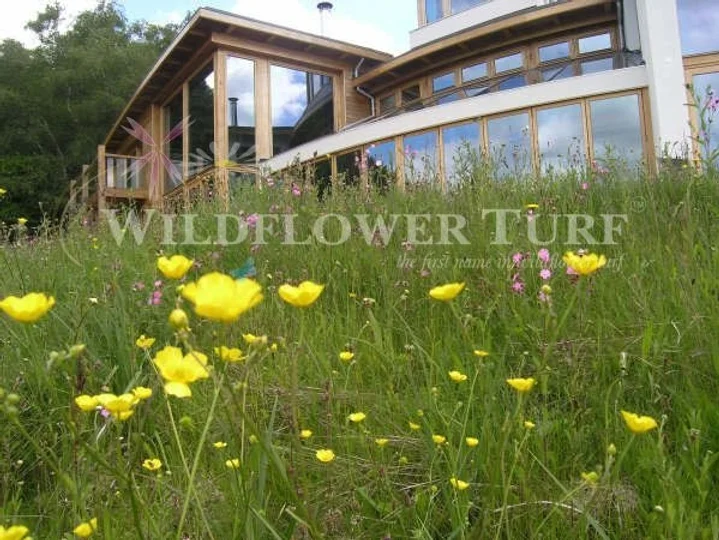
Wildflower turfgrass is also an ideal candidate for consideration for proposed ‘problem sites’, where, for example poor soil structure and low fertility may rule out laying to traditional lawn or planting. Futhermore, wildflower turfgrass is readily adaptable to extreme topographical or physical characteristics of the site (i.e steep slopes), which again may rule out normal vegetative cover, purely on the basis of growing success and the maintenance practicalities involved for the homeowner.

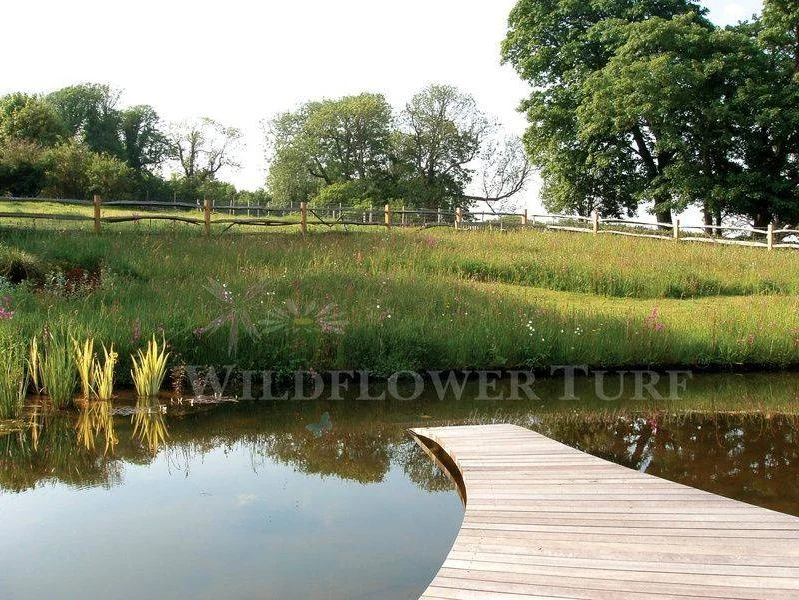
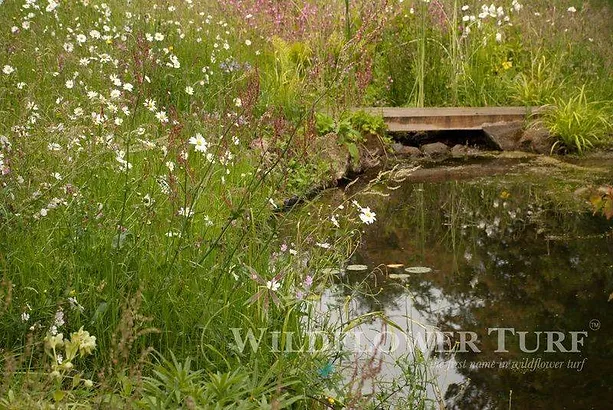
Wildflower turfgrass may also be installed on ‘green roof’ systems, being tolerant of water run off, various pitch angles etc, that may be encountered on such installations. Another characteristic making wildflower turfgrass particularly condusive to green roofs is its soil-less specification, making it lighter in weight than traditional turfs and thus reducing the overall supported weight of any such roofing system. Furthermore the dense vegetative cover of the turfgrass helps give it good insulating properties, needed for such builds.
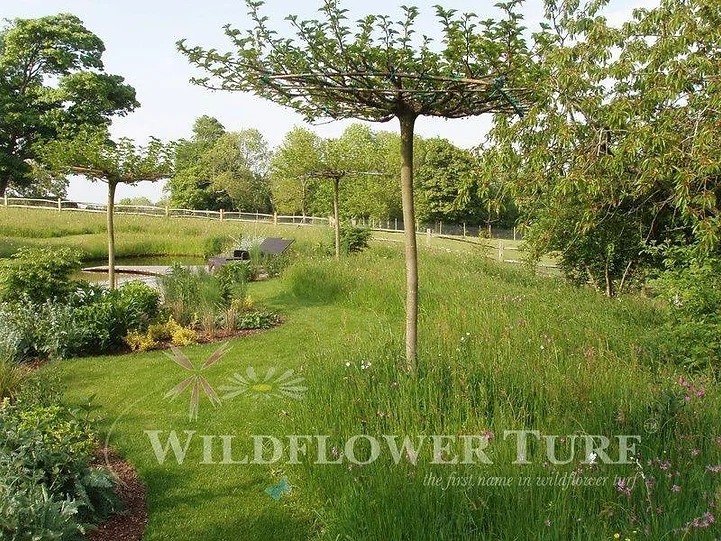

Once established the Wildflower turf requires very little maintenance activity, however, there is one important task to carry out each autumn; to cut the plants and remove these cuttings from the site
An open sward over the winterperiod helps ensure a healthy and disease free plant habitat which can benefit from what meagre light is available to them during the onset of winter. As the spring approaches and the soil temperature raises, the wildflowers and grasses are in perfect condidtion to capitalize on the improve climate conditions to develop flowers and seed heads quickly to repeat their perennial cycle thus ensuring a wildflower meadow year upon year.
Wildflower Turf Specifications
| Common Name | Latin Name |
| Wildflower content | |
| Autumn Hawkbit | Leontodon autumnalis |
| Betony | Stachys officinalis |
| Birdsfoot Trefoil | Lotus corniculatus |
| Bladder Campion | Silene vulgaris |
| Cat’s Ear | Hypochoeris radicata |
| Common Knapweed | Centaurea nigra |
| Common Sorrel | Rumex acetosa |
| Common Toadflax | Linaria vulgaris |
| Common Vetch | Vicia sativa |
| Cowslip | Primula veris |
| Field Scabious | Knautia arvensis |
| Lady’s Bedstraw | Galium verum |
| Meadow Buttercup | Ranunculus acris |
| Meadow Cranes-bill | Geranium pratense |
| Meadowsweet | Filipendula vulgaris |
| Musk Mallow | Malva moschata |
| Ox-eye Daisy | Leucanthemum vulgare |
| Ragged Robin | Lychnis flos-cuculi |
| Red Campion | Silene dioica |
| Ribwort Plantain | Plantago lanceolata |
| Rough Hawkbit | Leotodon hispidus |
| Salad Burnet | Sanguisorba minor |
| Self-heal | Prunella vulgaris |
| Perforate St Johns Wort | Hypericum perforatum |
| Tufted Vetch | Vicia cracca |
| White Campion | Silene latifolia |
| Wild Carrot | Daucus carota |
| Wild Marjoram | Origanum vulgare |
| Wild Red Clover | Trifolium pratense |
| Yarrow Milfoil | Achillea millefolium |
| Grasses | |
| Sheeps Fescue | Festuca ovina |
| Crested Dogs Tail | Cynosurus cristatus |
Wildflower seed proportions by volume
All watermarked photos courtesy of Wildflower Turf Ltd